
We Keep Calling It Strength—Even When It Isn’t
The Fastest Way to Misunderstand History is to Start in the Middle


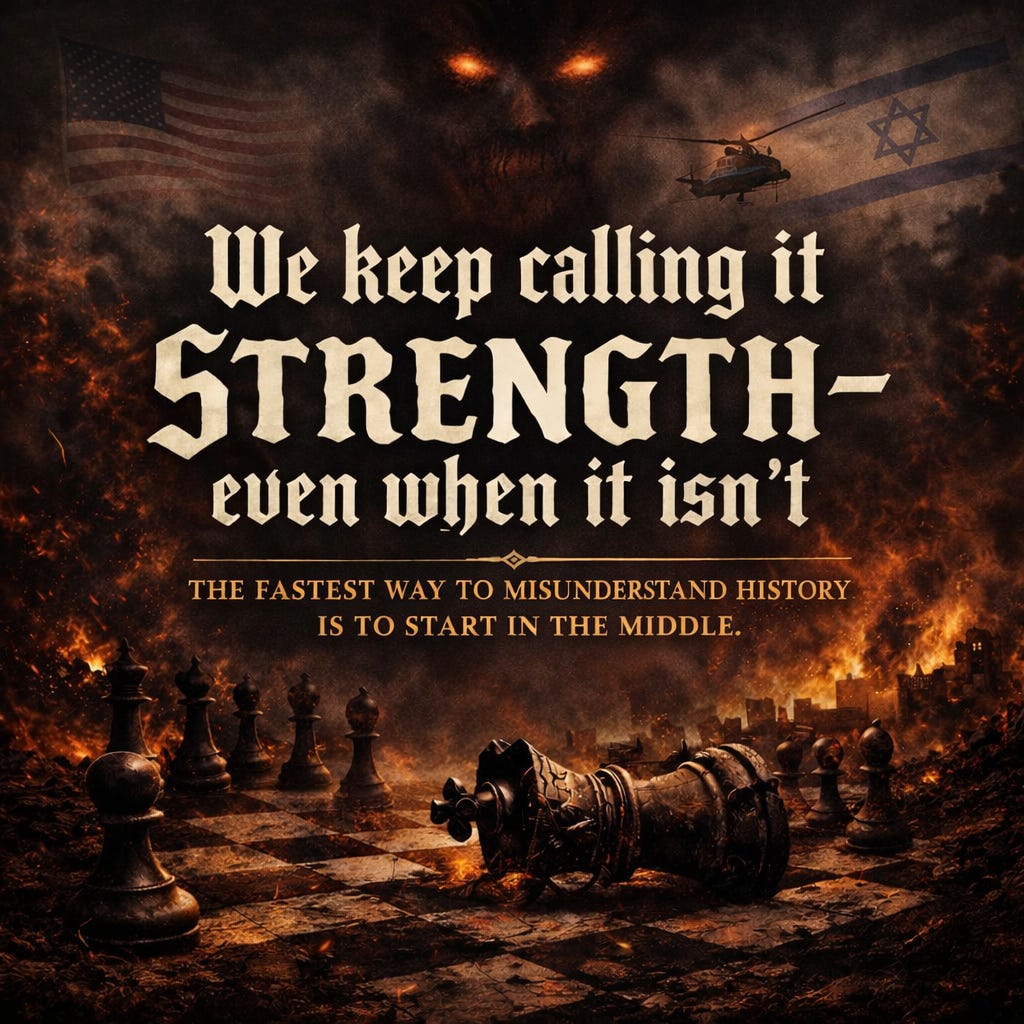
Something about this moment feels too clean. The propaganda isn’t even strong enough anymore.
A ceasefire gets announced. The rhetoric cools. And almost immediately, the conclusion spreads: this is what strength looks like!
Huh???
The strange part isn’t just the claim. It’s how quickly it hardens into certainty—before the ceasefire has even held, before the details have settled, before anyone has had time to ask -what actually changed ??
If you slow down—even for a moment—the story starts to feel less complete. The terms being discussed were already on the table weeks ago and they were drawn up by Iran! The shift looks less like a breakthrough and more like a rapid off-ramp after things got too close to the edge. The US escalated the bombastic rhetoric, Iran stood firm, and now the US is saying the 10 point plan drawn up by Iran is a reasonable framework. And that raises a harder question.
What exactly are we looking at?
The deeper problem isn’t just misreading this moment. That is a habit that has been around for longer than I can even articulate.
There’s something distinctly American about the way we process events like this. We prefer clean stories, decisive causes, and clear winners. We are a culture crafted, in part, by Hollywood. More than anything, we prefer to start history at the point where it flatters our conclusions.
So often with Iran, we like to start in 1979 and say: look how irrational they are!
But if you start earlier, the picture changes.
1953 Iranian coup d’état
A democratically elected leader was removed. A foreign-backed ruler was installed. Decades of political reality were shaped by outside power. That doesn’t justify what came later. But it does mean it wasn’t born out of nowhere.
When you ignore that, you don’t get clarity—you get a story that feels true because it’s incomplete.
The same thing happens with the Iranian hostage crisis.
It gets framed as pure hostility, a clean example of why strength is necessary. Then it’s tied to a familiar conclusion: Ronald Reagan takes office, Iran fears what’s coming, and the hostages are released. Case closed!
Except it wasn’t that simple. Negotiations were already underway. Terms were already being finalized. Timing, internal politics, and pressure from multiple directions were all converging at once.
But we compress all of that into one explanation—because it’s easier to carry.
They were afraid!!
Now take that same instinct and apply it to the present.
Tension rises. Rhetoric escalates. Then a pause—and immediately we declare: it worked again! We love a Hollywood ending.
But what if what we’re actually watching isn’t strength producing peace, but escalation forcing a retreat- possibly by the US? What if the pause isn’t proof of control, but evidence that things moved too fast and had to be dialed back?
Those are very different readings. And one of them requires you to admit that the situation was never as simple as it first appeared.
We’ve seen this pattern before.
The Vietnam War, Iraq War, and War in Afghanistan to name only a few.
There was strength. There was confidence. There were early moments that looked like success.
And then there were years—decades—of consequences that didn’t fit the original story. Whoops.
If we’re being honest, the United States hasn’t experienced anything resembling a clear, decisive victory in war since World War II. And to do that, “we” had to partner with the regime that was responsible for the deaths of millions of Orthodox Christians. Do you ever hear anyone discuss the spiritual implications of that, by the way?
And yet the language never changed.
We still talk as if every engagement is a win, every escalation is control, every outcome proves the strategy.
Because the truth doesn’t show up right away.
It shows up years later—sometimes decades later—when the costs are finally undeniable and the narrative can’t hold anymore.
That’s a very uncomfortable truth. You will still hear folks who supported every one of those failures, without repentance, support the current war. Not one lesson learned. “This one is totally different!” If you fall for the voices on the TV time after time, it may be time to sit this one out.
Strength is real. But so is memory. So is blowback. So are second- and third-order consequences that don’t show up in the first headline.
And when you ignore those, you don’t get wisdom. You get narratives that feel good in the moment and age poorly over time. The American Way can often be narrowed down to “feel good now-pay later”.
But there’s an even deeper layer most people never touch.
We are constantly tempted to look at events like this only through a geopolitical lens—strategy, leverage, timing, power—as if history is just a chessboard and the only question is who made the better move.
But that lens is incomplete. Because it also trains us to focus only on what is visible.
Let us not forget something St Paul warned about: For we wrestle not against flesh and blood, but against principalities, against powers, against the rulers of the darkness of this world, against spiritual wickedness in high places.
We are given the names, the leaders to watch, the personalities that fill headlines and cable news segments. And we begin to believe that what we’re seeing is the whole story.
But history doesn’t work like that. The world doesn’t work like that.
Power is layered. Influence is often indirect. And decisions are shaped by forces that don’t always have a face attached to them—at least not one we’re shown.
That doesn’t mean everything is hidden. But it does mean everything isn’t obvious. And when you assume the visible layer is the only layer, you don’t just miss details-you miss reality. Have we already forgotten 2020?
And this is where something more dangerous happens.
We begin to turn our explanations into identities, our frameworks into loyalties, and our preferred interpretations into something we defend—not because they are true, but because they are ours.
At that point, it’s no longer analysis. It’s devotion.
Ideology becomes an idol.
And once that happens, anything that challenges the story feels like a threat—not to your argument, but to you. So the story has to be protected, simplified, repeated, and defended—even when reality starts to contradict it.
This is why people get pulled so easily into narratives like this.
Not because they’re stupid, but because the narrative offers clarity, control, and the illusion that history is on their side. And that is a powerful temptation.
So before declaring this a victory, it’s worth asking a better question:
What actually caused this pause?
Because if your answer is too clean, too immediate, and too convenient, there’s a good chance you’re not looking at reality. You’re looking at a story. And we’ve seen what happens when we mistake stories for truth.
We call it strategy.
We call it strength.
We call it a win.
And then, years later, we call it something else. Whoops.
Calling this “peace through strength” while the ceasefire is already shaking is exactly how we misread history in real time. When the story gets simpler, you should get more suspicious—not less. What we worship will always shape what we’re willing to believe.
The greatest blindness is not political. It is spiritual.
 | A guest post by
|
The fastest way ti understand history is to understand it as the product of class struggle