
Opinion Is Morality
What Happens When Truth Becomes Subjective


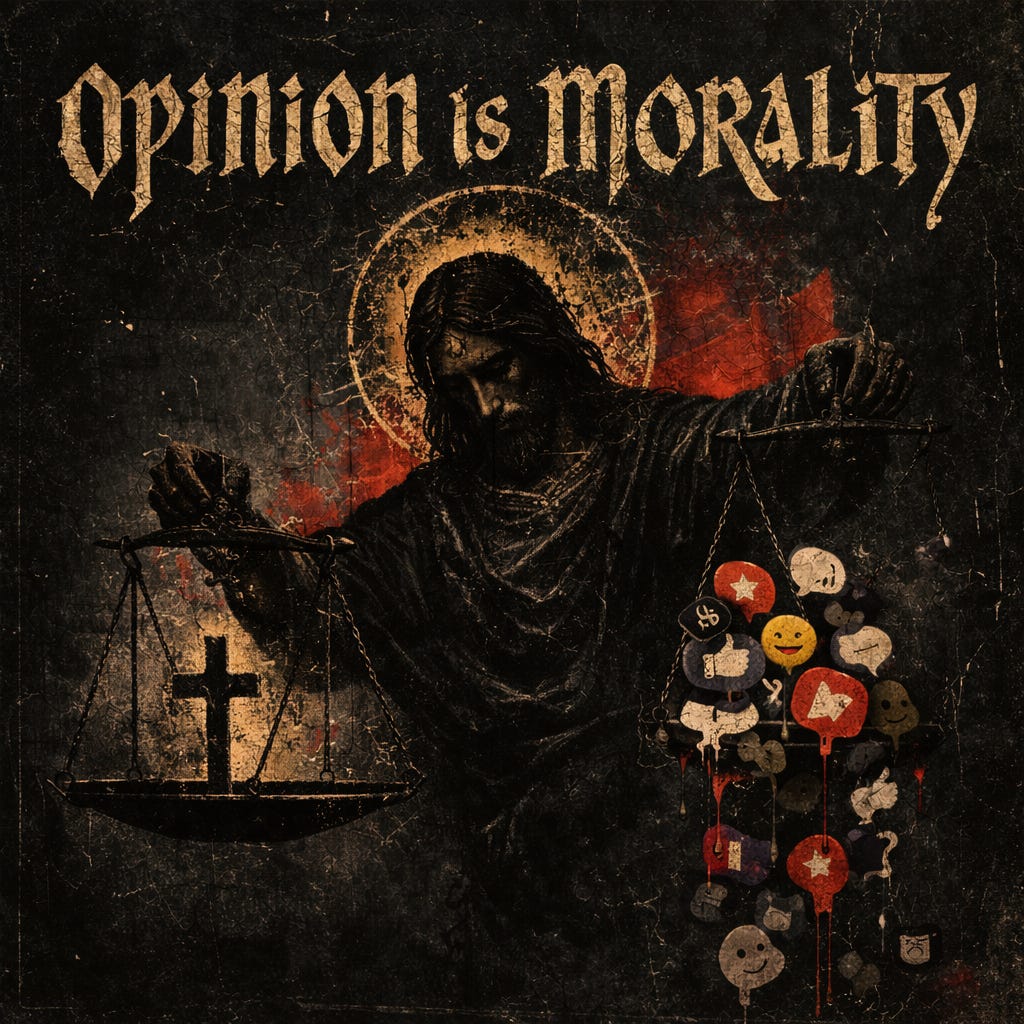
I’ve been having a running debate with a friend about truth, morality, and religion.
Nothing hostile. Just a friendly back-and-forth.
And to be clear — this piece isn’t meant to take shots at someone I genuinely like and enjoy talking with.
The reason the conversation stuck with me is because the worldview he described is incredibly common.
I suspect far more people believe something like it than we realize.
At one point he said something that perfectly summed it up:
“Opinion is morality.”
I’ve been thinking of that sentence since he said it.
Because that one line explains an enormous amount about how many people in our culture actually see the world and understanding that can be helpful.
This phenomenon is common- not necessarily because people have studied philosophy or carefully reasoned their way there — but because our culture has slowly absorbed the assumption that truth is personal and morality is subjective.
We still use words like right, wrong, justice, and evil.
But more and more, those words simply mean:
“What I think.”
One of the strangest things about debating a complete subjectivist is watching the category of fact slowly dissolve.
Several times during the conversation I would make a straightforward factual point.
Nothing controversial. Just a fact.
His response would be:
“I disagree.”
But disagreement only really works when we’re talking about opinions.
You can disagree about whether a movie is good.
You can disagree about which restaurant is best.
But facts don’t quite operate that way.
You don’t disagree with facts. You either accept them, misunderstand them, or reject them.
Once someone rejects the idea of objective truth entirely, everything becomes an opinion by default.
Facts become opinions.
Morality becomes opinion.
Reality itself becomes negotiable.
At that point debate becomes something strange — because debate only works if truth actually exists.
Once everything becomes opinion, “I disagree” stops being a rebuttal.
It becomes an escape hatch.
At one point I asked him a simple question.
“What’s your worldview?”
He said that he believes murder is wrong.
Good. So do I.
But when I asked why murder is wrong, his answer was revealing.
“Because as a society we all agree it’s wrong.”
At first glance that sounds reasonable.
But the moment you think about it for a second, something strange appears.
So I asked him a follow-up question.
“If society agreed tomorrow that murder was acceptable… would murder become morally right?”
He thought about it for a moment.
Then he said something interesting.
It wouldn’t be right to him personally, he said. But if most people believed it was acceptable, he would understand that.
That answer reveals something important.
Murder doesn’t actually become wrong.
It simply becomes something he personally dislikes.
In other words, it stops being evil.
It just becomes unpopular.
And once morality becomes personal preference, something important disappears.
Authority.
Because if morality is only opinion, the strongest statement anyone can make about evil is simply:
“I personally don’t like that.”
That’s not morality.
That’s preference pretending to be ethics.
At various points in history entire societies have agreed that slavery was acceptable, or that religious minorities could be persecuted.
If morality is simply whatever society agrees upon, then those things weren’t actually wrong at the time.
They were simply the majority opinion.
The real question isn’t whether we feel murder is wrong.
The real question is why it is wrong in the first place.
Eventually our conversation moved to religion.
He explained that he struggles to believe Christianity because things like the talking snake in Genesis or Christ turning water into wine don’t make scientific sense to him.
Then he said something that clarified everything.
“My values are based on what I think. I’m the final arbiter of morality for me.”
That might be the clearest summary of modern moral philosophy I’ve ever heard.
In this framework, the individual becomes the ultimate authority over good and evil.
But here’s the interesting thing.
That idea isn’t modern at all.
It’s ancient.
In Genesis, the serpent tells humanity:
“You will be like God, knowing good and evil.”
The temptation wasn’t simply to disobey God.
The temptation was to replace God as the authority over good and evil.
In other words:
You decide.
And once the individual becomes the final authority, moral language itself starts to change.
Words like sin, virtue, and vice begin to sound unnecessary — or even oppressive.
And speaking of sin, that’s where the conversation went next.
He told me he doesn’t believe in sin, and therefore something like gluttony isn’t a sin.
But disbelief doesn’t determine reality.
Not believing in gravity doesn’t stop gravity.
In the same way, rejecting the concept of sin doesn’t eliminate the reality it describes.
Even people who reject the word sin still recognize behaviors that wreck human lives.
Addiction.
Cruelty.
Greed.
Christianity didn’t invent the idea that some behaviors damage the human person.
It simply names the reality.
There’s another interesting thing about this worldview.
People who believe truth is subjective still argue about things.
Which is interesting when you stop and think about it.
Because arguing only really makes sense if one of us could actually be wrong.
Debate assumes something simple- truth exists.
Reason can move us closer to it.
Arguments can reveal reality more clearly.
But if everything is opinion, there’s nothing to discover.
There’s only preference.
Yet even the most committed subjectivists still argue as if truth exists.
They expect evidence to matter.
They expect reasoning to matter.
They expect contradictions to matter.
Which raises another realization.
Debating someone who rejects objective truth can quickly become an odd exercise.
Because if a person believes their own opinion is the ultimate authority, arguments don’t really function the way they normally do.
Evidence doesn’t settle the question.
Reason doesn’t settle the question.
In the end, the final judge is simply the individual mind.
And if the self becomes the highest authority, then nothing outside that mind can truly overrule it.
At that point discussion stops being a search for truth and becomes something closer to a comparison of perspectives.
Which means persuasion becomes extremely difficult.
In that kind of framework, truth often has to be encountered another way.
Not through argument but through experience.
Through consequences.
Through moments when reality pushes back hard enough that it becomes difficult to ignore.
And even then, the greatest obstacle is often not the evidence itself.
It’s the ego.
Human beings have an astonishing ability to defend their own ideas.
Sometimes the ego would rather watch the world burn than admit it was wrong.
Pride has always been one of the most stubborn obstacles to truth.
The real question isn’t whether people have opinions.
The real question is whether good and evil exist independently of our opinions about them.
Because if they don’t…..then morality becomes preference.
And if morality becomes preference, the strongest moral statement anyone can make about evil is simply:
“I personally don’t like that.”
That’s not morality.
That’s taste.
Which raises a simple question.
If good and evil are only opinions…why do we argue about them as if they’re real?
The modern world often celebrates the idea that each person should decide good and evil for themselves.
But that idea isn’t progress.
It’s simply the oldest temptation in human history.
And if that temptation succeeds, the result isn’t freedom.
It’s confusion.
Because when everything becomes opinion…
even truth itself becomes negotiable.
Truth doesn’t become freer.
It becomes impossible.
 | A guest post by
|
This brings to mind the recent discussion between Jay and Tim.
You bringing your core point bringing today’s acceptable norms back to Genesis is a stroke of genius. Exactly.